

Central Vietnam’s Coastal City, Urban Base and Regional Gateway
Da Nang
Destination at a glance
QUICK FACTS


Destination overview
Da Nang works because several different travel experiences sit unusually close together: an active city around the Han River, a broad urban coastline around My Khe, the forested Son Tra Peninsula to the north and a southern corridor toward the Marble Mountains and Hoi An. The airport is close to the traditional urban core, so arriving, changing areas and combining city time with the coast involves less friction than in many larger destinations. Vietnam’s 2025 administrative reorganization greatly expanded Da Nang City by merging the former Da Nang municipality with Quang Nam Province. For travelers, however, the search term “Da Nang” still usually means the traditional urban-coastal destination around the Han River, My Khe, Son Tra and the southern city. Hoi An and My Son now sit within the enlarged municipality administratively but remain distinct travel entities that deserve their own planning. For most first-time visitors, two days gives a useful introduction, while three to four days lets Da Nang function as a standalone beach-and-city destination rather than merely an airport stop for somewhere else.
What Defines Da Nang
- Coastal urban life: Da Nang combines a large modern city with a beach that is part of everyday life rather than a distant resort zone.
- Han River city: the river gives the urban center a clear orientation and creates a strong evening rhythm around bridges, promenades, dining and city lights.
- Beach culture: My Khe and the coastal strip support swimming, sunrise activity, cafés, seafood and accommodation within the city itself.
- Nature at the city’s edge: Son Tra, coastal viewpoints and the limestone landscape toward the south give Da Nang a stronger nature component than its modern skyline first suggests.
- Central Vietnamese food: noodles, seafood, markets and casual local dining make eating part of the destination rather than just a support service between sightseeing stops.
- Regional connectivity: the airport, railway and road network make Da Nang the most practical transport anchor for combining Hoi An, Hue and other Central Vietnam destinations.

Da Nang at a Glance
Da Nang is best understood as a standalone coastal city first and a Central Vietnam gateway second. Its value is not limited to being the nearest airport for Hoi An. Travelers can base here for beach mornings, local food, riverfront evenings, urban convenience and quick access to forested and limestone landscapes at the edges of the city.
The traditional visitor core is easy to read geographically. The Han River divides the central urban area from the main beach side; My Khe and the coastal strip create a second center of gravity; Son Tra rises to the north; and the southern edge transitions toward the Marble Mountains and the route to Hoi An. These zones are close enough to combine but different enough that accommodation choice changes the feel of a stay.
Da Nang’s administrative meaning changed substantially in 2025, when the former Da Nang municipality and Quang Nam Province were merged into a much larger centrally governed city. That means places such as Hoi An and My Son are now inside Da Nang City in an administrative sense. This guide deliberately focuses on the traditional Da Nang urban-coastal travel core, because that is what most international travelers still mean when they search for Da Nang as a destination.
This distinction is useful rather than technical. It keeps current geography accurate without collapsing separate visitor decisions into one enormous municipality. A traveler can stay in Da Nang, visit or stay in Hoi An, continue to Hue, or use Da Nang as the most efficient transport anchor for a wider Central Vietnam trip.
What Does “Da Nang” Mean After the 2025 Merger?
There are now two valid ways to use the name Da Nang, and travelers benefit from knowing the difference.
Administratively, Da Nang City is much larger than it was before July 2025. The former Da Nang municipality and Quang Nam Province were merged into one centrally governed city. As a result, Hoi An and My Son are now inside Da Nang’s administrative boundary.
In travel planning, Da Nang usually still means the traditional coastal urban destination. That is the area built around the Han River, My Khe Beach, the airport, Son Tra and the southern urban corridor. Hoi An remains a separate place to stay and experience, and My Son remains a separate heritage excursion. Keeping those travel entities distinct makes an itinerary much easier to understand.
This page therefore uses “Da Nang” mainly in the traveler’s sense while acknowledging the current municipality when location context matters.
Understand Da Nang in Four Practical Zones
A first-time visitor does not need to memorize wards. A four-zone mental model is more useful.
Han River and the central city: this is Da Nang’s main urban core, with markets, local restaurants, commercial streets, riverfront walks and convenient access to the airport and railway station.
My Khe and the main coastal strip: this is Da Nang’s primary urban beach zone, where accommodation, cafés and restaurants extend parallel to the coast and the beach forms part of everyday city life.
Son Tra and the northern coastal edge: the city gives way to forest, hills and wider coastal views. It is better understood as Da Nang’s nature edge than as another downtown district.
The southern coastal transition: the urban beach continues toward the Marble Mountains and the road to Hoi An. This area connects the city’s resort coast, limestone landscape and southern regional route.
These zones explain most visitor decisions without turning the page into an attraction list.
How Many Days Should You Spend in Da Nang?
One day is selective. It is enough for travelers passing through who want a quick sense of the coast and city, but it forces a choice between experiencing Da Nang itself and using the day for a major excursion.
Two days is a useful first introduction. This gives enough time to experience the beach and urban core at different times of day while adding one nature, cultural or regional component without making every hour a transfer.
Three to four days is the stronger range if you want Da Nang to stand on its own. You can enjoy slower beach time, local food, the Han River, one or two major outlying experiences and still have enough flexibility for heat or weather changes.
Longer stays make sense when Da Nang is your regional base. Families, beach-focused travelers and people who prefer one hotel can use the city for a more relaxed stay while making selected trips toward Hoi An, Hue or nearby nature. That does not mean every surrounding destination should be reduced to a day trip; overnight stays elsewhere can still be the better choice when the place itself is a priority.
Choosing a Base in Da Nang
Da Nang has three main stay patterns: the My Khe–An Thuong beach side, the Han River–Hai Chau city side, and the southern resort coast.
The beach side keeps the coast close to everyday life, the Han River side puts markets, local food and the urban centre closer, while the southern coast is better suited to travelers who expect the resort itself to be an important part of the trip.
For most visitors, the neighbourhood is only the first decision. The exact hotel location, real beach access, surrounding streets, tour pickup arrangements and late check-in policy can matter more than the area name shown on a booking site.
For a detailed comparison of My Khe, An Thuong, Han River, Non Nuoc and Son Tra — plus the hotel checks to make before paying — see our Where to Stay in Da Nang guide.
Da Nang Has a Daily Rhythm That Helps You Plan Better
Da Nang is easier to enjoy when you work with the city’s climate and local rhythm rather than treating every hour equally.
Early morning belongs naturally to the coast. Beaches are cooler, local residents are already exercising or swimming, and the city feels active without the midday heat.
Midday is better for food, rest or shorter indoor stops during hotter months. Trying to force long exposed walks into the hottest part of a summer day adds fatigue without improving the experience.
Late afternoon and evening shift attention toward the Han River, neighborhoods and dining. The city becomes more social after the heat drops, and the riverfront works as an urban evening space rather than a daytime landmark to collect.
This beach-morning and city-evening pattern is not a fixed itinerary; it is simply one of the most useful ways to reduce heat and unnecessary movement.
Da Nang Is More Than an Airport for Hoi An
Da Nang’s closeness to Hoi An creates a common planning mistake: treating one destination as a substitute for the other.
Hoi An is strongest for compact heritage streets, craft culture, a slower historic-town atmosphere and nearby countryside. Da Nang is strongest for a modern coastal-city lifestyle, broad beaches, urban food, the Han River, larger transport infrastructure and faster access to both nature and regional routes.
If your trip is short, either city can be used as a base for visiting the other. But staying in both can make sense because evenings and mornings are part of what distinguishes them. A Hoi An day visit does not recreate staying near its Ancient Town, just as sleeping in Hoi An does not recreate a Da Nang morning on the city beach followed by a local urban evening.
The better question is not “Da Nang or Hoi An?” but how much of your trip should be modern coast and city versus living heritage and smaller-town atmosphere.
Flying into the city? Our Da Nang Airport guide explains T1/T2, airport transport and what to expect after landing.
Getting Around: Think in Short Urban Crossings and Longer Regional Moves
Da Nang is spread out, but its main visitor zones are relatively straightforward to connect.
Ride-hailing services and taxis are the lowest-friction choice for most first-time visitors, especially when crossing between the beach and Han River sides or traveling with children and luggage.
Walking works best within a chosen zone rather than across the entire city. The riverfront, central blocks and individual stretches of the beach are flat and easy to explore on foot, but the city is too dispersed to treat walking as the main transport mode for every trip.
Motorbikes add flexibility for experienced riders, particularly toward the coast and wider city, but Son Tra’s slopes, wet roads and unfamiliar traffic make confidence more important than convenience.
For major outlying experiences and regional transfers, a private vehicle, organized tour or appropriate bus service often makes more sense than repeatedly piecing together short rides.
For taxis, Grab, motorbikes, private drivers and walking areas, see our guide to getting around Da Nang.
The Airport Is Part of Da Nang’s Travel Advantage
Da Nang International Airport sits close to the traditional urban core, which changes the practical feel of the destination. Arrival does not require a long transfer before the trip begins, and an early flight does not automatically force travelers to sacrifice the previous evening.
This low-friction gateway is one reason Da Nang works well at either the beginning or end of a Central Vietnam journey. It also makes split stays easier: travelers can combine Da Nang with Hoi An or Hue without needing to return to a distant airport zone the night before departure.
The airport should be seen as an advantage of staying in Da Nang, not as evidence that the city exists only for transit.
Who Will Enjoy Da Nang Most?
Da Nang suits travelers who want the convenience of a city without giving up easy access to the sea and nature.
Families benefit from broad beaches, straightforward road transport, large accommodation choice and the ability to mix easy city time with selected day experiences.
Couples can combine beach stays, seafood, river evenings and quieter nature without committing to a resort-only holiday.
First-time visitors to Central Vietnam benefit from the airport and transport network, especially when combining several destinations.
Longer-stay travelers may appreciate the balance of cafés, local food, beach access and everyday urban services more than a destination built mainly around sightseeing.
Travelers focused almost entirely on preserved historic streets may prefer more nights in Hoi An or Hue, while travelers who want a modern coastal base usually get more value from staying in Da Nang itself.
If you are still deciding how to spend your time, start with our guide to the best things to do in Da Nang
Use Da Nang as an Anchor, Not a Reason to Rush the Region
Da Nang sits at the center of one of Vietnam’s most useful multi-destination corridors. Hoi An lies to the south, Hue to the north, and Phong Nha can extend the journey farther north into caves and jungle.
Its transport infrastructure makes Da Nang an efficient anchor, but efficiency should not flatten every nearby destination into a day trip. Hoi An benefits from an overnight stay when heritage atmosphere matters; Hue deserves time when imperial history is a priority; Phong Nha requires its own planning for caves and outdoor experiences.
Da Nang’s strongest regional role is therefore connector plus destination: a place worth staying in for its own beach, food, river and nature, while also making the rest of Central Vietnam easier to organize.
Weather
Weather and travel conditions
Weather in Da Nang
Da Nang has a tropical monsoon climate with a broadly drier, sunnier part of the year and a wetter late-year period. The weather matters most for beach conditions, outdoor sightseeing and travel on exposed coastal or mountain roads.
March through August is broadly the drier period and is usually the easiest window for combining beach time with outdoor activities. Heat builds through late spring and summer, so early mornings become more useful for the coast and exposed walking.
The wetter season becomes more important from early autumn into winter. Heavy rain and tropical weather systems can affect sea conditions and outdoor plans, with October and November typically deserving the most flexibility.
Seasonal patterns are useful for choosing a month, but they cannot guarantee swimming conditions or clear skies on a specific day. Check the short-term forecast and local sea conditions close to travel.
When to go
Best time to visit
Best Time to Visit Da Nang
March through May offers one of the easiest balances for many first-time visitors, with generally drier conditions and less intense heat than the middle of summer.
June through August can be excellent for beach-focused trips, but midday heat becomes a larger planning factor. Early starts, shade and a slower afternoon pace make outdoor days more comfortable.
The wetter late-year months can still suit travelers who prioritize food, city life and flexibility over guaranteed beach conditions. Heavy rain and tropical weather systems are the main trade-offs rather than a reason to consider the destination closed for the season.
Local culture
Culture and local character
Modern Coastal Life and Central Vietnamese Identity
Da Nang’s cultural identity is contemporary rather than museum-like. It is a working coastal city shaped by fishing communities, markets, family-run food businesses, new urban development and a riverfront that has become one of the city’s main public spaces.
The Han River helps explain modern Da Nang. Bridges, promenades and dense development on both banks connect older commercial areas with the newer beach side, creating a city whose daily life is split between river and sea.
Traditional Central Vietnamese culture is still visible in food, neighborhood temples, markets and community life, while the surrounding region adds deeper Cham, Buddhist and imperial historical layers. Those relationships matter, but Da Nang does not need to imitate Hoi An or Hue to justify a stay.
Its distinctive experience is the combination of modern urban convenience, coastal routines and quick access to landscapes that become forested or mountainous within a short distance of the city.
Local food
What to eat and how food fits the trip
Food in Da Nang
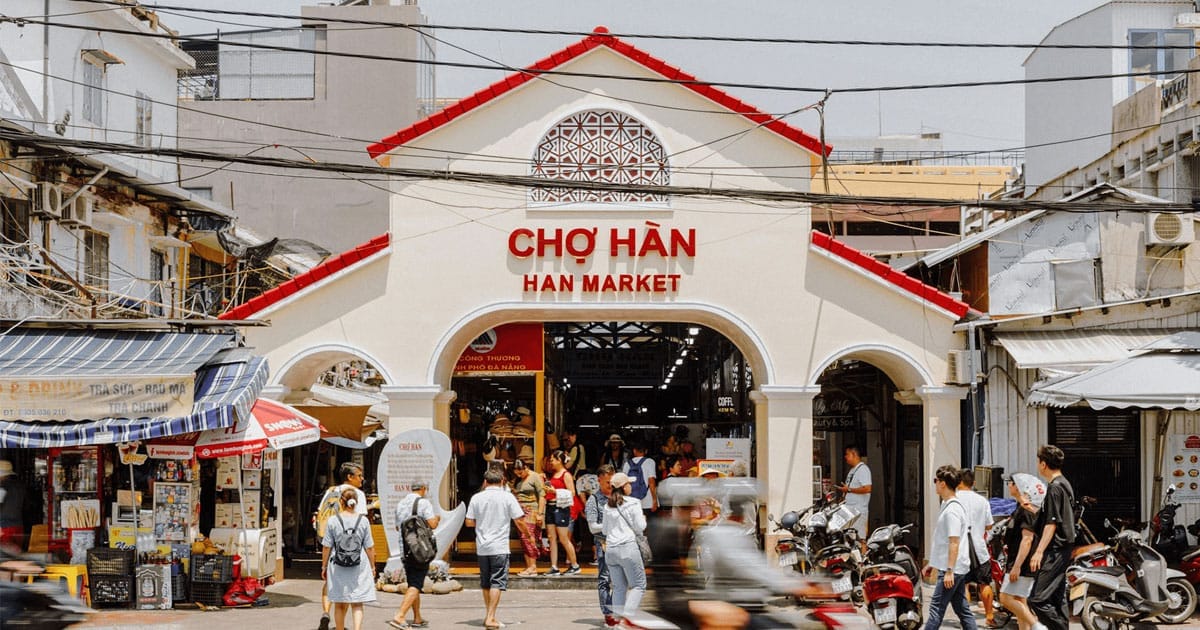
Da Nang’s food reflects its Central Vietnamese identity and coastal setting. Mi Quang, bun cha ca, wrapped dishes and seafood are useful starting points, while markets and neighbourhood eateries offer a different experience from beach-side and hotel dining.
Food is easiest to enjoy when it fits the geography of your day rather than becoming a separate cross-city checklist. Central Da Nang works well for local noodles and market food, while the coastal side naturally suits seafood and evening dining.
If food is an important part of your trip, use our Da Nang Food Guide to decide which meals to prioritise, how to order local dishes and seafood, which market to choose, and what to check for dietary restrictions.
Arrival planning
How to get there
How to Get to Da Nang
Da Nang International Airport is the main aviation gateway for Central Vietnam and sits close to the traditional urban core. Domestic and regional international services make the city a practical entry point for Da Nang itself as well as wider journeys through Central Vietnam.
Da Nang is also on Vietnam’s north–south railway, giving travelers a scenic and practical alternative to flying when connecting with Hue and destinations farther north or south.
Major roads connect the city with Hoi An to the south and Hue to the north. Private transfers, taxis, buses and other road services vary by route, so check the actual option and timetable for your travel date rather than relying on an old schedule.
For a Central Highlands extension, compare the Da Nang to Da Lat direct-flight guide and check the operating days before you book.
Getting Around After Arrival
- Taxi or ride-hailing: the easiest all-round option for crossing between beach and city zones.
- Walking: effective within the Han River center, individual neighborhoods and sections of the beach, but not for crossing the entire city.
- Motorbike: flexible for experienced riders, especially for wider city exploration, but optional for most first-time visitors.
- Private vehicle or organized transport: useful for major outlying experiences and regional transfers.

Practical planning
Travel tips for planning your stay
Practical Tips for Visiting Da Nang
- Think in zones. Stay flexible between the beach, Han River, Son Tra and southern corridor rather than choosing your hotel around one attraction.
- Use early mornings for the beach in hotter months. Conditions are cooler and local coastal life is most visible before midday heat builds.
- Do not judge the whole city by one side of the river. The beach zone and central urban zone have different food, atmosphere and walking patterns.
- Treat Son Tra as real hill and forest terrain. Roads become steeper and conditions can change with rain, so confident riding matters if you use a motorbike.
- Keep regional trips selective. Da Nang makes Hoi An, Hue and other destinations accessible, but an easy road connection does not mean every place is best experienced as a quick return trip.
- Carry some Vietnamese dong. Hotels and larger restaurants commonly accept cards, while markets and smaller local eateries are often easier with cash.
- Check short-term weather and sea conditions. Seasonal patterns are useful for planning, but actual swimming and outdoor conditions depend on the day.
Why plan with CentralVietnamTour?
Destination advice should help you organize the trip, not just list places. We focus on practical Central Vietnam planning, realistic routing and local context for international travelers.
Planning questions
Destination FAQ
Q: How many days should I spend in Da Nang?
Q: What does Da Nang mean after the 2025 merger?
Q: Should I stay in Da Nang or Hoi An?
Q: Is Da Nang worth staying in or just using for the airport?
Q: Can I explore Da Nang without joining a tour?
Q: Do I need a motorbike in Da Nang?
Q: What is the best time to visit Da Nang?
Q: Is Da Nang suitable for families?
Q: How does Da Nang fit into a Central Vietnam trip?
Q: How do I get to Da Nang?


Destination photos
Gallery


What to see and do
Top attractions and places to explore
Nearby Attractions



Organized experiences
Tours in this destination
Related Tours
10 Hours 3 Hours
Getting around
Transfers and transport connections
Transfers


Plan in more detail
Travel guides and practical reading
Related Travel Guides


Continue your route


