
Quick answer: use a mixed payment setup in Da Nang rather than searching for one “best” payment method: keep one main international debit or travel card, enough Vietnamese dong (VND) for cash-first situations, and a second payment method stored separately. ATM costs can differ materially by bank and card network, so compare the current machine fee instead of relying on an old “free ATM” list. As current reference points, BIDV’s 2026 tariff for foreign-issued Visa/Mastercard lists a 4.5–5% withdrawal fee with a minimum of 90,000 VND before VAT, while Techcombank’s published tariff lists 66,000 VND per withdrawal for the relevant foreign-issued Visa/Mastercard category.
When an ATM or card terminal offers to convert the transaction into your home currency, do not accept it automatically. Visa says Dynamic Currency Conversion (DCC) often carries roughly a 3–5% markup. Unless you have deliberately compared and accepted the displayed rate, choose VND and let your own card issuer handle the conversion.

Da Nang money at a glance — checked September 2026
| Decision | Current verified reference | What it means for a traveler |
|---|---|---|
| BIDV ATM with foreign-issued Visa/Mastercard | Effective 6 January 2026: 4.5–5% of the withdrawal amount depending on the tariff area, minimum 90,000 VND, before VAT | Do not assume a bank-branded ATM is automatically cheap; read the fee before confirming. |
| BIDV maximum per withdrawal | 5,000,000 VND for Visa/Mastercard in the current tariff table | A large cash need may require more than one transaction, which can multiply fees. |
| Techcombank ATM | 66,000 VND per withdrawal for the foreign-issued Visa/Mastercard category covered by its tariff | A fixed operator fee is easier to compare, but your own issuer may still add charges. |
| DCC | Visa says home-currency conversion often carries about a 3–5% markup | Compare before accepting; VND is normally the cleaner choice when you do not want DCC. |
| Da Nang Airport ATMs | Public ATM access at T1 and T2; the airport currently lists BIDV, SeABank, HSBC and VietinBank locations | You can solve the first cash need at DAD without planning an immediate city-bank stop. |
| Foreign QR payment | Cross-border VietQRGlobal connections expanded in 2026, including participating Singapore apps and Weixin Pay | Foreign QR can work, but a random overseas banking app should not be assumed compatible. |
These are current reference points, not a permanent “best ATM” ranking. ATM tariffs, limits, card-network rules and your own issuer fees can change. The final confirmation screen at the machine remains the operational authority for that withdrawal.
Use a four-part payment stack in Da Nang
| Layer | Best use | Main risk to control |
|---|---|---|
| Main international card | Hotels, larger restaurants, malls and planned purchases where your network is accepted | Foreign-transaction fees, merchant acceptance and DCC |
| VND cash | Markets, street food, small independent businesses and transport contingencies | Carrying too much cash or confusing denominations |
| ATM or authorised exchange | Refilling VND when needed | ATM operator fee, issuer fee, exchange markup or unlicensed exchange |
| Separate backup | Recovery if the main card is blocked, lost or retained | Keeping every payment method in the same wallet |
The advantage of this setup is not that any one method is perfect. It is that one payment failure does not stop the day. A card terminal can be offline, an ATM can reject a card, a market stall can prefer cash, or an overseas banking app can fail to recognise a local QR code. For the wider city context around where these payment situations arise, use the Da Nang travel guide.
For total-trip budgeting, use the Da Nang Travel Cost guide. This page focuses on how to access and use money day to day rather than how much the whole holiday should cost.
Understand VND before your first purchase
Vietnam’s official currency is the Vietnamese dong, written as VND or ₫. Prices are commonly shortened in speech and menus: “50k” means 50,000 VND.
The most useful banknote warning is specific: check the number, not only the colour. Vietnam Tourism specifically warns that the 20,000 VND and 500,000 VND notes come in similar shades of blue. That is a 25-fold difference in value, so count the zeros before handing over a note, especially when tired after a flight or paying in low light.
Count change before leaving the counter. If an ATM or exchange desk gives you a badly torn or heavily damaged note, resolve it there rather than discovering later that a merchant is reluctant to accept it.
Use VND as the working unit for normal spending. Even when a business can discuss a price in USD or another currency, comparing the actual VND amount makes it easier to see what you are being charged.
Your first six hours: solve arrival, not the whole trip
You do not need to obtain the entire trip’s cash at Da Nang International Airport. You only need enough payment access for the transfer, first meal and a reasonable contingency until you reach your accommodation.
Da Nang International Airport says ATMs are available in public areas of both T1 and T2. Its current FAQ lists BIDV, SeABank and HSBC on the ground-floor public Arrivals Hall, with VietinBank on the second-floor check-in level near Entrance A. Currency exchange is also available at the airport.
For international arrivals, the airport currently publishes exchange support for AUD, CAD, CHF, EUR, GBP, HKD, JPY, KRW, SGD, THB and USD. If you arrive with another currency that is not on that published list, do not assume the airport can exchange it.
A simple arrival rule works well:
- If your airport transfer is prepaid and your hotel accepts cards, obtain only the VND you expect to need soon.
- If you still need to pay for transport, food or a small purchase, use a bank ATM or an airport exchange counter after checking the cost.
- If the airport exchange quote is unattractive, exchange only enough for arrival rather than converting the whole holiday budget.
- Do not make a phone-based QR app your only arrival payment method before mobile data, app access and compatibility are confirmed.
For terminal navigation, arrivals and transport, use the Da Nang Airport Guide rather than turning the money decision into a full airport guide. If you prefer to remove the first-ride payment decision entirely, a pre-arranged private driver can simplify arrival, but it is optional rather than necessary.
Cash or card? Choose by the transaction, not the neighbourhood
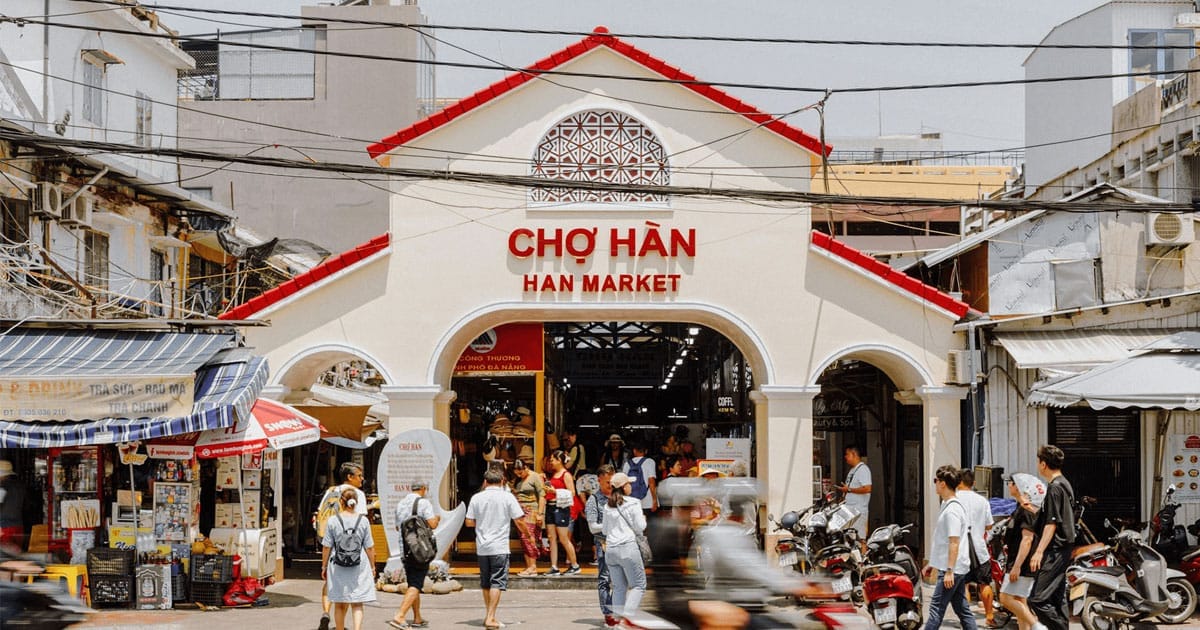
Cash is still useful where acceptance matters more than rewards or convenience: traditional markets, street-food vendors, small independent businesses and situations where a card terminal is unavailable. Do not assume every stall follows the same rule; carry VND as the fallback and ask before ordering when cash is limited. If a market visit is part of your day, the Con Market visitor guide covers the visit itself while this page keeps the payment decision in scope.
Cards are useful for larger, traceable payments at merchants that clearly accept your network. Before tapping or inserting a card:
- confirm the amount is in VND;
- ask whether a card surcharge applies;
- check the terminal before approving the transaction;
- decline DCC unless you have intentionally compared and accepted its rate;
- keep the receipt or transaction alert for larger purchases.
Do not assume every business on the same street behaves the same way. A hotel, chain café and small family-run restaurant can all have different payment practices.
The practical rule is to carry enough VND to finish the next part of the day without turning cash into your entire travel fund.
ATM fees in Da Nang: current examples matter
A good ATM guide should not pretend every bank behaves the same way.
BIDV: current foreign-card fee can be substantial
BIDV’s current tariff notice for foreign-issued Visa and Mastercard lists a cash-withdrawal fee of 4.5–5% of the transaction amount, with a minimum of 90,000 VND, before VAT. The tariff also states that issuer-side fees are separate. Its current table lists 5,000,000 VND as the maximum per withdrawal for Visa/Mastercard.
That means the old travel-blog advice “BIDV is free” is not a safe general rule for foreign-issued Visa/Mastercard in 2026.
Techcombank: published fixed withdrawal fee
Techcombank’s currently published tariff, accessed in September 2026, lists 66,000 VND per ATM withdrawal for the category shown in that tariff, which excludes Visa/Mastercard cards issued by banks in Vietnam and JCB cards. Your own bank or card issuer can still add a foreign ATM fee or foreign-exchange markup.
What traveler reports are useful for — and what they are not
Recent traveler discussions can be useful for finding banks or ATMs to compare, but reports about “free” withdrawals, high limits or a machine working with one card are not durable fee evidence. Treat community reports as leads only; the current ATM confirmation screen and your own card issuer’s terms are the operational authority for the transaction you are about to make.
This is exactly why older “best ATM in Vietnam” lists age badly. Use community reports as leads, then trust the current ATM screen and your issuer’s terms.
A 30-second ATM decision sequence
Before pressing Confirm, run this sequence:
- Check the requested amount. Make sure it is useful enough to justify any fixed fee but not more cash than you want to carry.
- Read the local operator fee. Treat it separately from anything your home bank charges.
- Reject DCC unless you deliberately want it. Choose VND / without conversion when you want your own issuer to perform the currency conversion. If the screen does not make the currencies, rate or choice clear enough for you to understand, do not approve a home-currency conversion just to continue quickly.
- Check the final amount again. Do not rush through an unfamiliar confirmation screen.
- If declined, stop and diagnose. Reduce the amount or try another bank-branded ATM rather than repeating the same failed request many times.
- Take the card before walking away. Then collect cash and receipt in the order the machine returns them.
A low operator fee does not automatically mean the withdrawal is cheap. Your total can include the Vietnamese ATM fee, your issuer’s overseas withdrawal fee, the issuer’s FX markup and DCC if you accept it.
DCC: the expensive convenience many travelers do not need
Dynamic Currency Conversion appears when an ATM or merchant terminal offers to charge your card in your home currency rather than VND.
Visa’s travel guidance explains that home-currency conversion often includes roughly a 3–5% markup through the exchange rate. When DCC is offered, compare the displayed home-currency conversion with the VND option before accepting it.
The practical response is simple: unless you have deliberately compared the displayed DCC rate and want it, decline the conversion and choose VND.
Choosing VND does not make the transaction fee-free. Your own card issuer can still charge for overseas withdrawals or foreign-currency transactions. It simply avoids accepting an additional conversion controlled by the ATM or merchant’s DCC provider.
Related Tours
 10 Hours
 3 Hours
Can foreign tourists use VietQR in 2026?
Sometimes — but not because every overseas banking app can scan every VietQR code.
Cross-border QR interoperability expanded materially in 2026. On 2 July 2026, NAPAS launched Vietnam–Singapore cross-border QR payments so users of participating Singapore payment apps can pay at VietQRGlobal acceptance points in Vietnam. On 6 August 2026, NAPAS, BIDV and Weixin Pay announced expanded Vietnam–China QR connectivity, allowing Chinese visitors to use Weixin Pay at VietQRGlobal acceptance points.
This changes the advice for international travelers in one specific way: foreign QR payment is now possible through supported cross-border schemes, but only when your app participates in the scheme and the merchant accepts the compatible VietQRGlobal route. A VietQR code being visible does not by itself prove that an arbitrary overseas banking app can pay it.
If you see a VietQR code at a café or shop:
- use it only if your own app explicitly supports that cross-border payment route;
- confirm the merchant name and VND amount before approving;
- do not assume a normal overseas banking app will work merely because it can open a camera scanner;
- keep a card or VND backup.
For most visitors, QR should be treated as an optional extra layer, not the only way to pay.
Where should you exchange money in Da Nang?
For the safest default, use a bank or a clearly authorised foreign-exchange agent. The Da Nang Visitor Center finance directory currently separates bank branches, ATMs and foreign-exchange agents, which is a useful starting point when you want a provider whose role is easier to verify.
A local-guide option: Triệu Việt Vương near the former Son Tra Night Market area
There is also a practical local comparison area that generic money guides often miss. In day-to-day guide work in Da Nang, travelers sometimes compare cash-exchange quotes along the short row of gold and jewellery shops on Triệu Việt Vương, near the former Son Tra Night Market frontage. Treat the area only as a place to compare quotes: popularity, signage or a travel recommendation does not prove that a particular shop is currently authorised to conduct the foreign-exchange transaction you want.
For that reason, this guide does not label any individual gold shop as the permanent “best rate” option. If you compare a quote in this area, ask for the net VND amount first and confirm that the provider is currently permitted to handle the transaction. If authorisation is unclear, use a bank or a clearly authorised foreign-exchange agent instead.
Treat that as a local comparison lead, not a guaranteed best-rate claim. Exchange rates move throughout the day and can vary by currency, note denomination and note condition. Ask for the net VND you will receive before handing over cash; for a material amount, comparing one or two nearby quotes on the same Triệu Việt Vương strip takes only a few minutes.
There is an important legal distinction. A gold or jewellery shop being popular with travelers does not by itself prove that every foreign-exchange transaction is currently authorised. Vietnam’s Decree 340/2025/NĐ-CP, effective 9 February 2026, provides sanctions for buying or selling foreign currency at organisations that are not permitted to exchange it. For the stated first-offence case below USD 1,000 equivalent, the decree provides for a warning; the relevant USD 1,000 to under USD 10,000 bracket carries a 10–20 million VND fine. If a shop’s current authorisation is unclear, use a bank or a clearly authorised exchange agent instead.
Whichever provider you choose:
- compare the net VND amount rather than only a “zero commission” sign;
- ask whether the rate changes by currency, note denomination or note condition;
- bring identification in case the provider requires it;
- count the VND before leaving;
- keep any receipt or exchange record separately from the cash.
At Da Nang Airport, exchange can still be sensible for an arrival amount. You do not need to spend a taxi ride and an hour of the first day chasing a small rate difference if convenience matters more than maximising every last dong.
Build your cash reserve around the next day
There is no honest universal answer to “How much cash should I carry in Da Nang?” because the right amount depends on what the next day contains.
| Day shape | Cash role | Planning logic |
|---|---|---|
| Hotel + mall + larger restaurants | Lower | Card acceptance is more likely, but keep a cash fallback. |
| Market + street food | Higher | More small vendors and low-value purchases make VND more useful. |
| Paid attraction day | Moderate fallback | Verify official ticket payment, then carry cash for incidental purchases and the return journey. |
| Regional or mountain outing | Prepare before departure | Do not assume an ATM will appear exactly when you need one. |
| Hotel-change or departure day | Protected reserve | Keep enough accessible funds for luggage transport and an alternative ride if one payment method fails. |
Payment friction tends to appear at transitions: airport arrival, a market purchase, departure for an outlying attraction or a late return. That is when a separate backup method matters most.
What to do if a card or ATM payment fails
A declined card does not prove the account lacks money. The merchant may not accept the network, the issuer may block the transaction, the terminal may be offline, or a security rule may have triggered.
- Do not repeatedly enter the PIN or submit the same transaction.
- Confirm the VND amount and merchant details.
- Check your issuer app or message for a security alert.
- Use the separate backup card or cash if the purchase is legitimate.
- If an ATM retains the card, record the bank name, machine location and time, then contact the bank and your card issuer through their official channels. Do not assume a nearby branch can immediately return a retained foreign card. When practical, using an ATM attached to an open bank branch can make it easier to seek help if something goes wrong.
Keep emergency cash and the backup card outside the main wallet. Losing one wallet should not remove every way to pay.
Keep money safety inside the right scope
Normal precautions are enough for most transactions: do not display the full cash supply, count money discreetly, verify the amount before approving a payment, and keep cards under your control.
For broader theft, transport, traffic and emergency decisions, use the Is Da Nang Safe? guide.
Nearby Attractions



Before leaving Da Nang
Do not spend the last VND the night before an early departure. Keep enough accessible money for the final ride, baggage needs and a backup payment if the first method fails.
If you have excess VND, use it for legitimate final expenses or ask an authorised provider about exchanging eligible notes. Small, damaged or unusual notes can be harder to exchange, and the final rate may differ from the rate you received when buying VND.
One-minute Da Nang money checklist
- Main international debit or travel card enabled for Vietnam.
- Backup card stored separately.
- VND matched to the next day’s cash-first needs.
- ATM operator fee checked before confirming.
- Home-bank ATM and FX fees understood separately.
- DCC declined unless intentionally compared and accepted.
- 20,000 and 500,000 VND notes checked carefully.
- Foreign QR treated as app-specific, not universal.
- Bank or authorised FX agent used for cash exchange.
- Enough accessible money kept for the final transport leg.
Frequently asked questions
Q: What currency is used in Da Nang?
Q: Should I use cash or card in Da Nang?
Q: Which ATM is best in Da Nang in 2026?
Q: How much can I withdraw at a BIDV ATM?
Q: Where are ATMs at Da Nang Airport?
Q: Should I choose VND or my home currency at an ATM?
Q: Can I pay with VietQR using a foreign banking app?
Q: Where should I exchange money in Da Nang?
Q: How much cash should I carry?
Practical travel planning and local operations knowledge for Central Vietnam.
About our local teamRelated Travel Guides



Planning a Da Nang trip?
Tell us your travel dates, destinations and group size. Our local team can help you plan the next practical step.
Plan My Trip