

Da Nang's working dragon-shaped bridge across the Han River, combining Ly Dynasty-inspired architecture, pedestrian access, night lighting and a central city setting.
Dragon Bridge
Visit at a glance
QUICK FACTS

Attraction overview
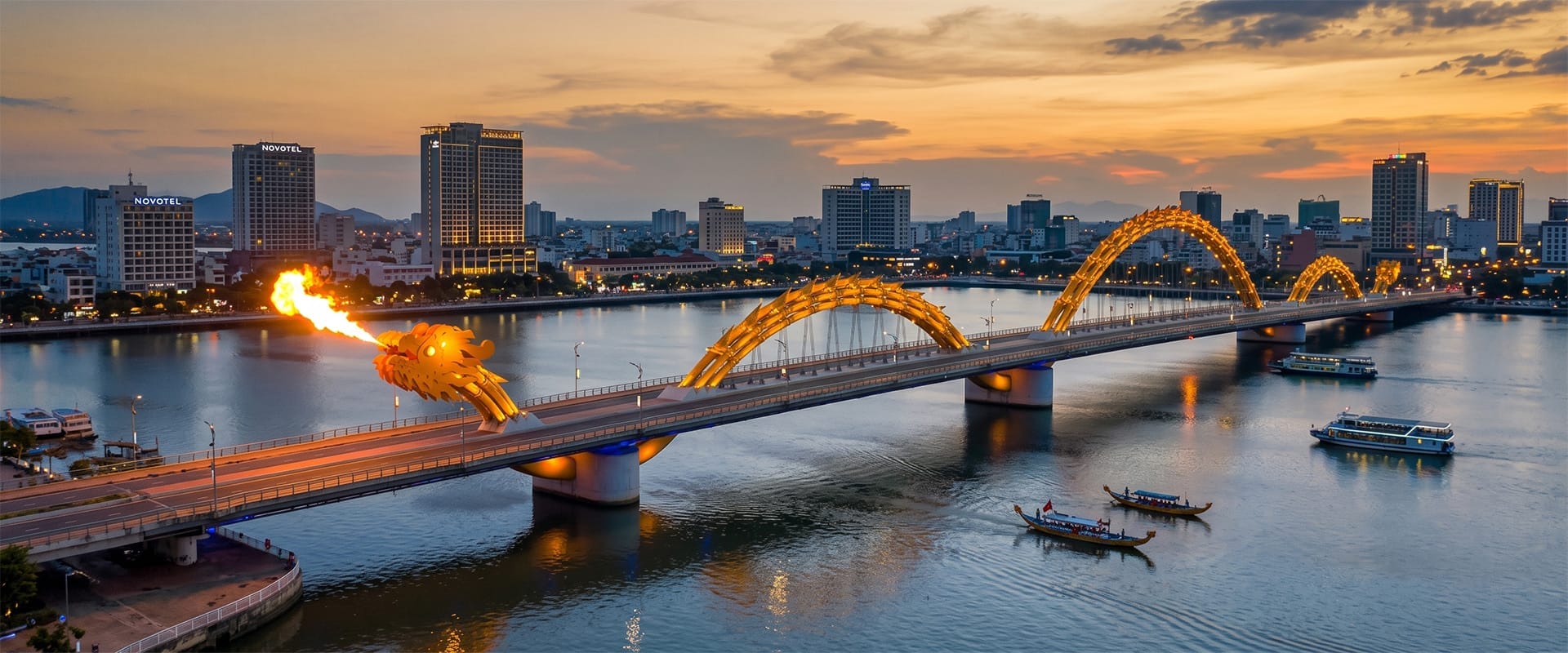
Dragon Bridge is worth visiting as a working city landmark, not only as the setting for a timed fire-and-water show. For architecture, Han River views and photography, it works as a short stop in central Da Nang, especially in late afternoon and around blue hour. If the performance is your priority, treat it as a separate timed event and check the current show guide shortly before your visit.
- A working city landmark: Dragon Bridge is both a major road connection and one of Da Nang’s most recognisable riverfront sights.
- Purpose-built dragon architecture: the six-lane bridge was developed after an international design competition and its form follows the dragon imagery of Vietnam’s Ly Dynasty.
- Designed to be experienced after dark: 2,500 LED lights illuminate the structure, so the bridge remains visually distinctive even when no performance is scheduled.
- Walkable as well as drivable: two pedestrian sidewalks run across the bridge, giving visitors a closer look at the structure and river setting.
- Best treated as a short city stop: architecture, river views and blue-hour photography are enough to justify a visit; detailed show-night planning belongs in the dedicated fire-show guide.
Is Dragon Bridge worth visiting?
Yes, but treat it as a compact city landmark rather than a half-day attraction. Dragon Bridge sits in the urban core, so it is easy to combine with the Han River waterfront, dinner, nearby sights or a wider city day.
During the day, the main value is the dragon-shaped structure, the river setting and the fact that this is still a working bridge. Around blue hour and after dark, the lighting gives it a stronger visual presence. If the fire-and-water performance is your main reason for coming, that changes the visit into a timed event and needs a different plan.
What makes the bridge itself worth seeing?
Dragon Bridge is more than a decorative crossing. The project was selected through an international design competition, and the six-lane structure was shaped to emulate a dragon from Vietnam’s Ly Dynasty. WSP’s project record also lists two 2.5-metre pedestrian sidewalks and 2,500 LED lights.
For visitors, those details change how to experience the landmark. You can walk part or all of the bridge for a close view of the structure, then step back to the riverfront when you want to see the full dragon shape, arches and city context in one frame.
Landmark visit or fire-show night?
These are related but different visitor decisions. Choose a normal landmark visit if you mainly want architecture, river views or photographs; it is flexible and can fit almost anywhere in a central Da Nang itinerary.
Choose a show-night visit only if the performance itself matters enough to plan around a fixed time, crowd movement and temporary traffic controls. Schedule, viewing position, arrival timing and exit logistics are intentionally kept in the Dragon Bridge Fire Show guide, where time-sensitive details can be maintained without turning this entity page into a duplicate show guide.
How should you see Dragon Bridge on a normal visit?
Start by deciding whether you want a close structural view or a complete riverfront composition. Walking on the bridge gives you the closest look at the dragon body and the Han River below, but normal city traffic remains part of the experience. A riverbank position sacrifices that close-up detail in exchange for a clearer view of the whole landmark.
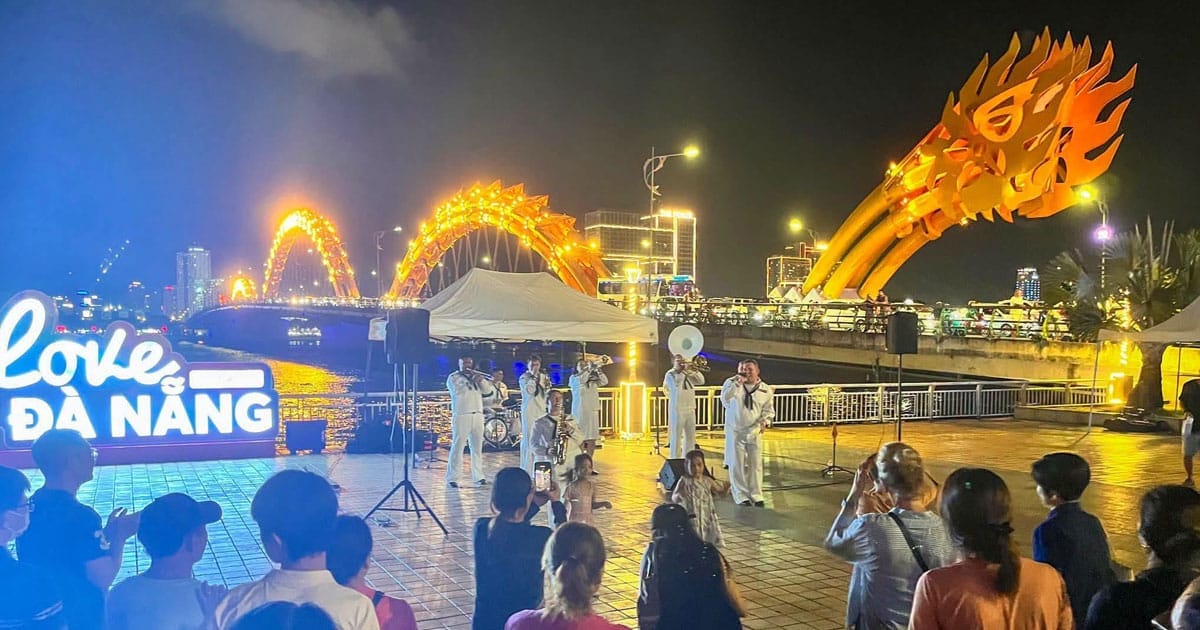
If you are already in the area, pair the stop with a Han River walk or the nearby Da Nang Love Bridge. That sequence makes more sense than arriving only for a quick photograph and then arranging another vehicle immediately.
Is Dragon Bridge still worth visiting without the show?
Yes, if you are already spending time in central Da Nang. Without the performance, Dragon Bridge is best treated as a short architecture, river-view and photography stop rather than a destination that needs a long block in the itinerary.
About 30–45 minutes is usually enough for an evening visit focused on lighting and photographs. A daytime stop can be shorter. For more choices that deserve a larger share of the day, see Things to Do in Da Nang.
When is Dragon Bridge best for photography?
If the bridge itself is the subject, blue hour is the most useful compromise: there is still detail in the sky while the bridge lighting and river reflections begin to stand out. Daylight is better when you want to inspect the steel structure and dragon form; full darkness puts more emphasis on the lighting and surrounding city glow.
For a wide photograph, move away from the dragon rather than staying directly beside it. The bridge is 666 metres long, so a little distance makes it easier to show the full form and its relationship with the Han River.
Do you need to walk across the whole bridge?
No. The pedestrian sidewalks make a crossing possible, but a full out-and-back walk is not necessary for most visitors. Walk far enough to get the close structural and river views you want, then continue across only when the opposite bank is already part of your route.
This is especially useful for families or older travelers: the landmark does not need to become a long walk simply because the bridge is pedestrian-accessible.
How should you fit Dragon Bridge into a normal Da Nang route?
Dragon Bridge works best when it is already on your central-city route. If you are staying around the Han River, walking to the riverfront can be simpler than arranging a vehicle for one short photo stop. If you are coming from the beach side or combining several city sights, decide the transport for the wider route rather than treating the bridge as an isolated transfer.
For the broader choice between walking, ride-hailing, taxi, private vehicle and other city transport, use Getting Around Da Nang. That keeps this page focused on the landmark itself while the transport guide owns the city-mobility decision.
How much time should you allow for Dragon Bridge?
For a normal landmark visit, use this simple framework:
- Daytime architecture or photo stop: about 15–30 minutes.
- Late-afternoon, blue-hour or night-lighting visit: about 30–45 minutes.
These are CVT planning recommendations rather than official attraction durations. If the timed fire-and-water performance is your priority, use the dedicated Dragon Bridge Fire Show guide for its separate arrival, viewing and exit plan rather than treating that event as a normal landmark stop.
If your planning question has become broader — for example whether to stay near the Han River or My Khe, or how many days to spend in the city — use the Da Nang Destination Guide. Travelers who want Dragon Bridge as part of guided daytime sightseeing can also see the Da Nang City 1 Day Tour; the tour treats the bridge as a city landmark rather than promising a timed evening performance.
Background and significance
History and context
Construction of Dragon Bridge began in 2009, and the bridge opened on 29 March 2013, marking the anniversary of Da Nang’s liberation. The structure is 666 metres long and carries six traffic lanes across the Han River.
The Da Nang People’s Committee commissioned the project to strengthen links between the city, the eastern seafront, the airport and the route toward Hoi An. After an international design competition, the bridge design was developed by the team now documented by WSP as Louis Berger and Ammann & Whitney. Its multi-arch form emulates a dragon from Vietnam’s Ly Dynasty, while two 2.5-metre pedestrian sidewalks and 2,500 LED lights make the structure usable and visually legible beyond its role as a road crossing.
That combination is what makes Dragon Bridge unusual: it is not a monument placed beside the transport network, but infrastructure that functions as part of everyday Da Nang while also carrying a deliberate cultural and visual identity.
Visit planning
Opening hours, tickets and best time
For the bridge itself, late afternoon into blue hour gives the best balance of visible architecture, bridge lighting, sky detail and Han River reflections. Daylight is better for inspecting the dragon structure and walking the bridge; full darkness puts more emphasis on lighting and the surrounding city. If the fire-and-water performance is your priority, check the dedicated Dragon Bridge Fire Show guide shortly before your visit because event schedules and traffic controls can change.
On-site advice
Practical tips for your visit
- Visit in daylight if you mainly want to inspect the dragon structure; choose late afternoon or blue hour when lighting and river reflections matter more.
- Use the pedestrian sidewalks for a closer look, but remember that Dragon Bridge remains a working road with normal city traffic outside temporary event controls.
- For a wide photograph, step back to the riverfront rather than trying to fit the whole 666-metre bridge into a frame from immediately beside the dragon.
- Pair a short visit with the Han River waterfront or nearby Love Bridge instead of allocating a half day to the landmark.
- If the fire-and-water performance is the reason for your visit, recheck the dedicated show guide shortly before your date because schedules and event controls can change.
Why plan your visit with CentralVietnamTour?
Useful attraction guides should help you understand the visit before you arrive — including timing, access, realistic pacing and how the stop fits the rest of your Central Vietnam itinerary.
Before you go
Attraction FAQ
Q: Is Dragon Bridge free to visit?
Q: Can you walk across Dragon Bridge?
Q: How long should you spend at Dragon Bridge?
Q: When is the best time to photograph Dragon Bridge?
Q: Is Dragon Bridge worth visiting without the fire-and-water show?
Q: Is Dragon Bridge the same as Golden Bridge at Ba Na Hills?


See more of the place
Full gallery
Visit with local support
Tours that include or connect with this attraction
Related Tours
 10 Hours

 3 Hours

Continue exploring nearby
Nearby attractions
Nearby Attractions



Plan in more detail


