

A living Buddhist temple where the most interesting contrast is between its hybrid East–West exterior and its strongly Vietnamese interior art.
Vinh Trang Pagoda
Visit at a glance
QUICK FACTS
Attraction overview
Look Beyond the Giant Buddha Statues
Vinh Trang Pagoda is one of the best-known religious landmarks in the My Tho area, but its real value is not only the three giant Buddha statues outside. The older temple preserves a layered architectural history, ceramic-mosaic gates, carved wooden interiors and a nationally recognized collection of religious art.
The pagoda is free to enter. A practical first visit takes around 45–90 minutes, although travelers who stop for worship, photography or a slower look at the interior can stay longer.
Start with the historic temple buildings before circling through the monumental statues. That order makes it easier to understand which parts belong to the nineteenth- and early twentieth-century pagoda and which are much newer additions.
What Deserves Your Attention
- The tam quan gates: colorful ceramic and porcelain mosaics illustrate Buddhist stories, auspicious animals, flowers and traditional motifs.
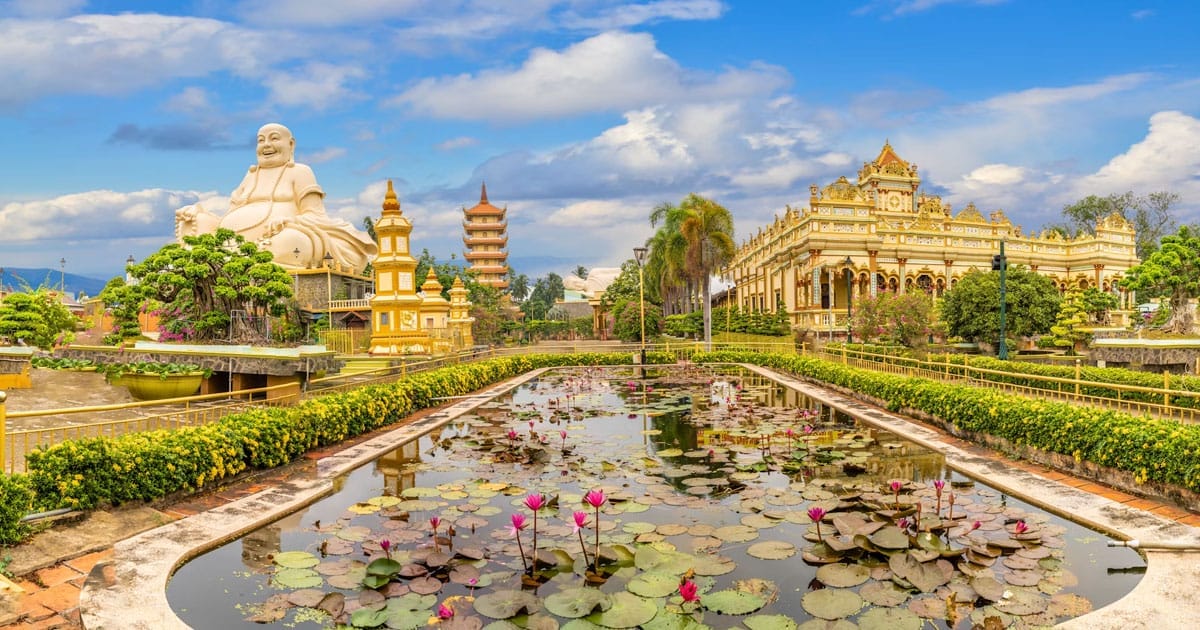
- The East–West architectural contrast: Renaissance-style decoration, Roman arches, French ironwork and Japanese tiles appear outside, while the interior remains rooted in Vietnamese religious woodwork and altar design.
- The 18 Arhat statues: carved from jackfruit wood in the early twentieth century, this set is among the pagoda’s most important works of sculpture.
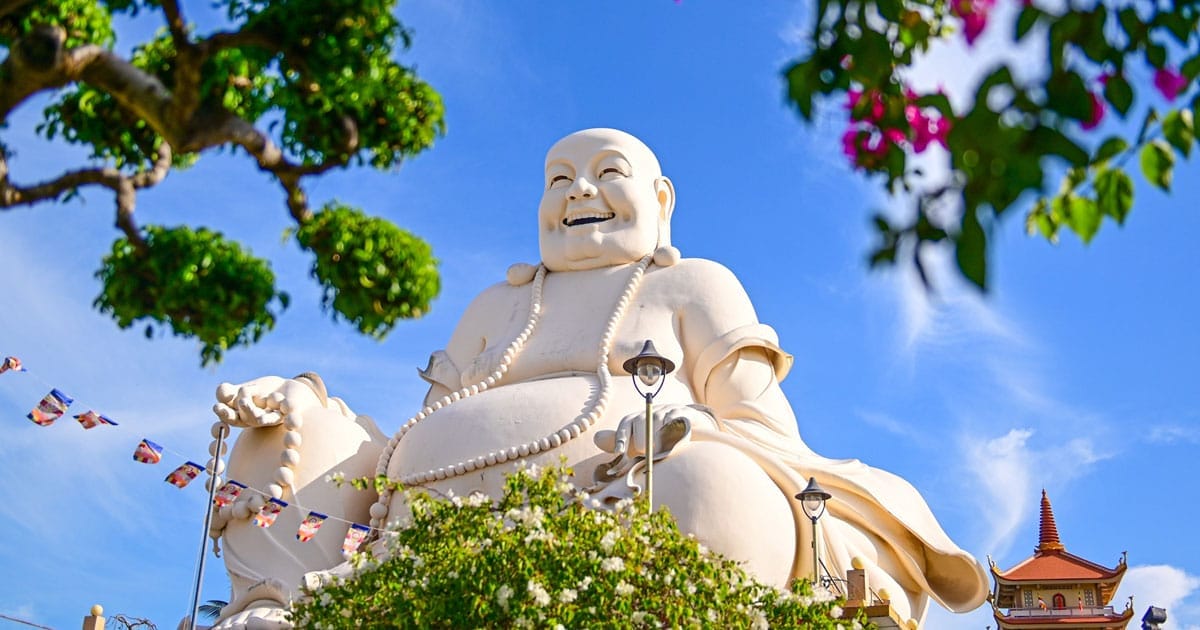
- The three monumental Buddhas: standing Amitabha, seated Maitreya and reclining Shakyamuni were added in the modern period and should be read separately from the older temple fabric.
- The living religious atmosphere: Vinh Trang is still an active place of worship, especially busy on the first and fifteenth days of the lunar month and major Buddhist observances.
Start at the Tam Quan Gate — It Explains the Pagoda Better Than a Photo of the Giant Buddhas
The entrance gates are among Vinh Trang’s most distinctive historic features. Their surfaces are covered with small pieces of ceramic and porcelain arranged into dragons, phoenixes, flowers, Buddhist stories and scenes from traditional life.
Spend a few minutes here before walking toward the statues. The gate introduces the visual language that continues across the complex: Vietnamese religious symbolism expressed through materials and decorative techniques that absorb outside influences without becoming a purely European building.
The Exterior Is Hybrid; the Main Hall Feels Much More Vietnamese
Many guides summarize Vinh Trang as “East meets West,” but that phrase hides the most useful architectural distinction.
Official tourism records specifically identify Renaissance-style motifs, Roman arches, French ironwork and Japanese ceramic tiles on the outer structures. Chinese characters use traditional seal-style calligraphy, while some Vietnamese lettering reflects Gothic-style forms.
Once you move inside, the impression changes. The main hall relies on traditional altar composition, precious timber columns, gilded carving, lacquered boards and Vietnamese Buddhist sculpture. The contrast between exterior and interior is more informative than trying to assign the whole pagoda to one architectural style.
The Oldest Art Is Inside, Not in the Three Giant Outdoor Statues
Vinh Trang preserves around 60 historic religious statues in wood, bronze and terracotta. Among the most valuable are the 18 Arhat figures, carved from jackfruit wood in the early twentieth century and arranged along the main hall.
The temple also preserves three mid-nineteenth-century bronze figures associated with Amitabha, Avalokiteshvara and Mahasthamaprapta, along with gilded carved panels and an 1854 bronze bell bearing the old temple name.
If you only walk around the garden statues, you miss the part of Vinh Trang that best explains why it is a nationally protected historic-cultural site.
The Three Giant Buddhas Are Modern Additions
The monumental outdoor statues are now the pagoda’s most recognizable visual landmarks, but they do not date from the nineteenth-century foundation.
The standing Amitabha Buddha was completed in the late 2000s and rises about 18 metres above its pedestal. The seated Maitreya Buddha reaches about 20 metres, while the reclining Shakyamuni Buddha extends roughly 32 metres in the nirvana posture.
They were added between 2008 and 2013. This is useful context for photographers and history-focused visitors: the giant statues represent the modern development of an active Buddhist complex, while the older architectural and artistic layers sit closer to the main hall.
Do Not Treat 1849 as the Construction Date of Everything You See
The pagoda’s story began earlier than 1849 with a small thatched hermitage established by retired district official Bui Cong Dat. After his death, Venerable Hue Dang expanded it into a major temple, completed in 1849 under the name Vinh Truong.
The building changed repeatedly afterward. Venerable Tra Chanh Hau rebuilt the main hall in 1907 and introduced stronger Asian-European architectural mixing; Venerable Minh Dang carried out a major renovation around 1930.
Vinh Trang is therefore best understood as a layered complex rather than a single building frozen in 1849.
Allow 45–90 Minutes for a Normal Visit
The current provincial tourism portal gives around two hours as a suggested stay, while several current visitor guides place a typical visit between 30 and 90 minutes.
For most independent travelers, 45–90 minutes is realistic for the gates, main hall, Arhat statues, gardens and three large Buddhas without rushing. Two hours makes more sense if you are praying, reading details carefully or photographing the architecture at a slower pace.
On a packaged Mekong Delta day tour, the stop may be shorter. If architecture is one of your main interests, ask how much time the itinerary actually gives you before assuming a tour visit is equivalent to an independent one.
Late Morning and Early Afternoon Are the Main Tour-Group Period
Vinh Trang sits on the standard road route used by many Ho Chi Minh City–My Tho day tours. Current local visitor guidance consistently notes that group traffic increases from late morning into the early afternoon.
For a calmer visit, aim for roughly 06:30–09:00 or return later in the afternoon. Early light also works well on the gate mosaics and the white Buddha statues before the courtyard becomes hot.
If spiritual atmosphere matters more than quiet photography, the first and fifteenth days of the lunar month and major Buddhist festivals are more active—but also busier.
Free Entry Does Not Turn the Pagoda into a Tourist Photo Set
There is currently no standard entrance ticket, and donations are voluntary. Vinh Trang remains an active religious complex, so visitor behavior should follow the worship setting rather than the fact that admission is free.
Cover shoulders and knees, remove shoes where requested before entering halls, keep voices low and avoid stepping in front of people praying. Outdoor photography is straightforward; inside the main hall, avoid flash and put the camera away when ceremonies or worship would be disrupted.
Visit It as Part of My Tho, Not Only as a Bus Stop from Ho Chi Minh City
Vinh Trang is only a few kilometres from the traditional center of My Tho and fits naturally before or after a Tien River boat trip.
That makes it more useful as a cultural anchor for a My Tho day than as a standalone reason to drive from Ho Chi Minh City. If you are arranging your own route, visit the pagoda early, then continue to the river area once the main temple courtyards begin filling with tour groups.
Background and significance
History and context
From a Small Hermitage to a National Heritage Pagoda
Vinh Trang began as a modest thatched hermitage established in the early nineteenth century by retired district official Bui Cong Dat. After his death, Venerable Hue Dang mobilized followers to expand the site into a large pagoda, completed in 1849 and named Vinh Truong.
Venerable Tra Chanh Hau rebuilt the main hall in 1907, introducing stronger Asian-European architectural features. A major renovation under Venerable Minh Dang in 1930 shaped much of the appearance visitors recognize today.
The Ministry of Culture recognized Vinh Trang as a national historical-cultural relic in 1984. In 2007, Vietnam’s record organization also recognized it for its distinctive combination of Eastern and Western architectural styles.
Visit planning
Opening hours, tickets and best time
Early Morning Is the Strongest Default
For most visitors, roughly 06:30–09:00 is the best balance of cooler temperatures, softer light and fewer organized tour groups.
Late afternoon can also work well for photography and lower heat. The pagoda is suitable throughout the year, so time of day matters more than choosing one specific travel season.
If you want quiet contemplation, avoid major Buddhist observances and the first or fifteenth day of the lunar month. If you want to see the temple at its most active, those same dates offer a stronger worship atmosphere but require more patience with crowds.
On-site advice
Practical tips for your visit
Practical Choices That Improve the Visit
- See the historic hall before the giant statues. It prevents the oldest art from becoming an afterthought.
- Arrive before the main day-tour wave. Early morning is cooler, quieter and better for photographing the facade.
- Dress for an active Buddhist temple. Cover shoulders and knees and remove shoes where signs or local practice require it.
- Do not rely on the provincial portal’s 23:00 closing time for a sightseeing visit. Current live visitor listings cluster around 18:00–19:00, so confirm directly if you plan to arrive late.
- Allow extra time on lunar worship days. The first and fifteenth days of the lunar month can be much busier than an ordinary weekday.
- Use the free admission as flexibility, not as a reason to rush. A voluntary donation is appropriate if you wish to support temple maintenance.
Why plan your visit with CentralVietnamTour?
Useful attraction guides should help you understand the visit before you arrive — including timing, access, realistic pacing and how the stop fits the rest of your Central Vietnam itinerary.
Before you go
Attraction FAQ
Q: Is Vinh Trang Pagoda free to enter?
Q: What are the current Vinh Trang Pagoda opening hours?
Q: How long should I spend at Vinh Trang Pagoda?
Q: What makes Vinh Trang Pagoda’s architecture unusual?
Q: Are the giant Buddha statues as old as the pagoda?
Q: What should I see first at Vinh Trang Pagoda?
Q: What should I wear to Vinh Trang Pagoda?
Q: When is Vinh Trang Pagoda least crowded?


See more of the place
Full gallery
Continue exploring nearby
Nearby attractions
Nearby Attractions


Plan in more detail