

A protected Mekong Delta wetland where the best visit depends on choosing the right boat experience, water level and time of day.
Tra Su Cajuput Forest
A Great choice for Central VietNam Tour
Share your details and our travel experts will call you back with personalized packages.
We'll call you soon


An amazing journey to explore local culture awaits you
QUICK FACTS
Rating Score: 4.4☆(7,564)GoogleMap

What Makes Tra Su Worth the Detour from Chau Doc
- Two very different boat experiences: the motorboat covers distance, while the rowing boat slows down inside narrower cajuput channels.
- High-water wetland scenery: seasonal water and floating green vegetation create the visual experience most associated with Tra Su.
- Real conservation value: official An Giang information records 70 bird species, including the Painted Stork and Oriental Darter listed in Vietnam’s Red Book.
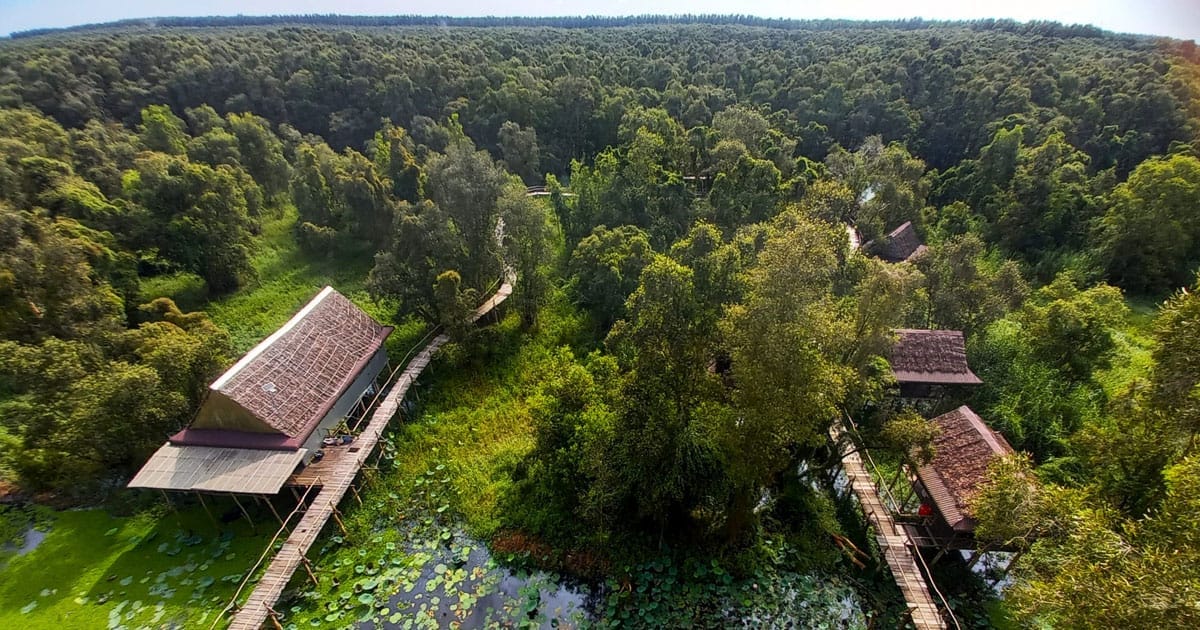
- Forest-level and canopy-level views: the rowing route shows the wetland at water level, while the observation tower gives context to the scale of the protected landscape.
- A long bamboo-walkway system: it adds a dry-land way to experience the forest, but the visitor route should not be confused with every “10 km bridge” claim repeated online.
Opening hours:
Official Visitor Hours: 07:00–18:00The current An Giang tourism listing shows Tra Su Cajuput Forest open from 07:00 to 18:00.The listing gives about 120 minutes as a normal visit, but travelers using both boat services, the observation area and walking sections should allow closer to 2–3 hours.No reliable official last-boarding time for the boat services was found. Do not treat 18:00 as a safe time to begin the route. For late-afternoon bird activity, arrive well before the final hour so the boat and walking sections can be completed before closing.Entrance Ticket:
120,000 VNDTra Su Is a Restored Wetland Forest, Not an Untouched Ancient Jungle
Many travel pages describe Tra Su as if the present forest had existed in the same form for centuries. Current An Giang tourism information instead states that the forest was formed in 1983 on low-lying acidic land.
That history makes the place more interesting, not less. Cajuput planting and wetland management helped create a functioning habitat that now supports a large range of birds, fish, reptiles and wetland plants.
The site was later incorporated into Vietnam’s special-use forest system as a landscape-protection area. When visiting, think of Tra Su as a managed conservation landscape with ecotourism infrastructure rather than a wilderness reserve without human intervention.
The Visitor Area Is Only Part of the 845-Hectare Forest
The protected forest covers about 845 hectares. Current provincial tourism information says roughly 159 hectares are used for tourism, with an additional landscaped area outside the forest.
This explains an apparent contradiction in visitor reviews: the entrance area contains photo installations, food services and recreational additions, while the deeper wetland still feels much quieter and more ecological.
If nature is your priority, do not spend most of your time at the decorative entrance zone. Move toward the water routes and observation areas first.
Use the Motorboat for Access, Then Slow Down on the Rowing Boat
The two boat services are not interchangeable. The motorboat moves through larger channels and carries visitors deeper into the tourism route. The rowing boat is slower, quieter and better suited to narrow waterways where cajuput trunks, floating plants and bird sounds are much closer.
Recent visitors repeatedly describe the rowing segment as the more peaceful part of the experience. Some also report that the motorboat can feel rushed depending on the driver and traffic.
If you must choose only one paid boat add-on, decide by purpose: choose the motorboat for route coverage and transport; choose the rowing boat for the classic slow forest experience. For a first visit, doing both gives the clearest sense of how the site is organized.
Do Not Assume Every Channel Will Have a Perfect Green Carpet
The bright green water surface seen in promotional photographs comes from floating wetland vegetation, including duckweed and other aquatic plants. Its density changes with water level, rainfall, current, season and maintenance of individual channels.
September to November is the safest period for the classic high-water appearance, and provincial tourism guidance extends the broader beautiful period into December. Even then, one channel may be thickly green while another is more open water.
Visit for the wetland ecosystem as a whole, not for a guarantee that every metre of the boat route will match a single edited photograph.
Morning and Late Afternoon Serve Different Visitor Priorities
For a cooler, quieter visit, arrive close to opening. Local and operator guidance commonly points to roughly 07:00–09:00 as a useful period for bird activity and comfortable temperatures.
Late afternoon can be stronger for watching birds return toward roosting areas. Local guidance often points to around 16:00–17:00 for that behavior.
The trade-off is closing time. The current official listing closes at 18:00, and no reliable public last-boat time was found. If late-afternoon bird activity is your priority, arrive early enough to complete the boat route before the site begins winding down rather than turning up near 17:30.
The Flood Season Is Best for Water Scenery, Not Automatically for Every Traveler
September to November is the strongest default for the flooded-forest experience: water levels are higher, the wetland looks fuller and aquatic vegetation becomes more visually dominant.
That does not make the rest of the year a failed visit. The operator itself promotes green summer conditions, and recent visitors outside peak flood months still report enjoyable boat trips.
Outside high water, expect a different balance: less dramatic flooding but potentially easier weather on some days and fewer peak-season groups. For photographers who specifically want the classic emerald-channel image, season matters more than it does for a traveler mainly interested in the ecosystem.
Birdwatching Is Real, but Do Not Treat Wildlife as a Scheduled Show
An Giang’s current tourism information records 70 bird species in the forest, including the Painted Stork and Oriental Darter among the rarer species associated with the wetland.
Bird activity changes with season, water level, feeding patterns and time of day. Large flocks are possible, especially around active morning and late-afternoon periods, but they are not guaranteed on a particular boat ride.
Bring binoculars if birdwatching matters to you. The observation tower helps with landscape context, but distant birds are easier to appreciate with your own optics than by relying on a wildlife sighting from the boat alone.
The “10 km Bamboo Bridge” Needs Context
Tra Su is widely promoted for having Vietnam’s record-setting bamboo bridge through a cajuput forest. Current tourism material often refers to a wider bridge system or planned/record length of around 10 km.
However, the attraction’s own current tariff page describes the bamboo bridge included in the entrance experience as about 2.2 km. For itinerary planning, do not assume that a normal visitor must walk a continuous 10 km route.
This matters for families and anyone trying to estimate visit duration. The bamboo walkway can be a substantial part of the visit, but you can combine selected walking sections with boats rather than treating the entire published record length as mandatory.
Budget for Entry and Boats Separately
The current operator tariff page lists 120,000 VND for admission. It separately lists the motorboat and rowing boat at 60,000 VND each, which would make 240,000 VND for entry plus both standard boat services.
However, several current 2026 visitor sources and recent reviews report 70,000 VND for each boat service, while a current An Giang destination guide gives a 190,000 VND walk-in visitor price without clearly itemizing the package.
The practical approach is to budget about 240,000–260,000 VND per adult if you want admission plus both standard boat experiences, then confirm the day’s posted tariff and inclusions at the ticket office before paying.
Tra Su Works Best as a Chau Doc or An Giang Stop, Not a Standalone HCMC Day Trip
The forest is roughly 20–30 km from the Chau Doc area depending on the starting point and route, making Chau Doc the most practical base for international visitors.
From Chau Doc, a half-day outing is enough for transport plus a 2–3 hour visit. It also pairs naturally with the Sam Mountain area, but trying to squeeze a meaningful Tra Su visit into a same-day road trip from Ho Chi Minh City creates far more travel time than forest time.
If Tra Su is one of the reasons you are visiting An Giang, stay locally and choose your forest timing around water level and bird activity rather than around a long intercity transfer.
Explore more travel information about Mekong Delta.
September–November for High Water; Early Morning for a Balanced Visit
The strongest default season is September to November, when Mekong floodwater gives the forest its fullest wetland character and floating vegetation becomes more prominent. Provincial guidance sometimes extends the broader attractive high-water period into December.
For time of day, 07:00–09:00 works well for cooler temperatures, softer light and active birdlife. Late afternoon, particularly around 16:00–17:00, can be rewarding when birds return toward roosting areas, but it leaves less margin before the 18:00 closing time.
Tra Su remains visitable year-round. Outside high water, expect a different landscape rather than assuming the attraction is closed or not worth visiting.
From Acidic Wetland to Protected Cajuput Habitat
Tra Su’s present forest landscape began taking shape in 1983, when cajuput was established on low-lying acidic land in the Long Xuyen Quadrangle.
Over time, the planted cajuput and surrounding wetland habitats developed into a valuable ecosystem supporting aquatic plants, fish, reptiles, mammals and a diverse bird community.
Current An Giang tourism information records Tra Su as a special-use landscape-protection forest, with the protection status dated to 27 May 2003. The site later developed managed ecotourism routes alongside its conservation role.
In 2020, Tra Su received Vietnamese record recognition associated with its flooded-forest tourism landscape and bamboo bridge. These tourism records are separate from the forest’s ecological protection status.
Small Planning Choices That Improve the Visit
- Buy by experience, not by a vague “combo” label. Confirm whether your ticket includes entry, motorboat, rowing boat or all three.
- Prioritize the rowing boat for quiet scenery. It is the slower segment through the narrower channels.
- Go early for cooler conditions. Around 07:00–09:00 is a practical default if photography and bird activity both matter.
- Protect your phone from splashes. A small waterproof pouch is more useful than carrying a large bag during boat transfers.
- Wear stable footwear. Boarding small boats and walking bamboo surfaces are easier in flat shoes or secure sandals.
- Do not promise yourself a specific bird species or a completely green canal. Both wildlife and floating vegetation respond to natural conditions.
Why Travel With Us?
Tailored to You: Custom itineraries matching your exact pace and passions.
Go Local: Authentic experiences guided by native experts.
Zero Stress: We handle all logistics—transport, tickets, and stays.
24/7 Support: Round-the-clock local assistance, whenever you need it.
Exceptional Value: Premium quality at fair, transparent prices.
Nearby Attractions


Let's plan your next vacation
A hundred years from now, no one in this world will remember you or me. We only come to this world once — to leave our footprints on new lands and to etch every moment deep into our memory.
Live for the experience. Start your journey today — book your tour and make memories that last a lifetime!
View Our Business & Travel Licenses
Book your holidayGallery
FAQ
Q: How much is the Tra Su Cajuput Forest entrance fee?
Q: What are the opening hours for Tra Su Cajuput Forest?
Q: What is the best time to visit Tra Su Cajuput Forest?
Q: Do I need both the motorboat and rowing boat?
Q: How long should I spend at Tra Su Cajuput Forest?
Q: Is the water always covered in bright green duckweed?
Q: Is Tra Su Cajuput Forest suitable for children?
Q: Is Tra Su Cajuput Forest close to Chau Doc?
BOOKING

Phong Nha–Ke Bang Named Asia’s Leading National Park 2026
Phong Nha–Ke Bang won Asia’s Leading National Park 2026 and Vietnam’s Leading Nature Destination 2026. [...]
Sep

Hue to Dong Hoi by Train: Schedules, Tickets & Phong Nha Connection
Choose the right Hue–Dong Hoi train by arrival window, seat or berth, luggage, HQ2 vs [...]
Sep

Da Nang to Phong Nha: Bus, Train, Private Car & Best Route
Compare direct buses, train via Dong Hoi, private cars and Da Nang Airport connections by [...]
Sep

Hue to Phong Nha: Bus, Train, Private Car & Best Way to Travel
Compare direct buses, Hue Northern Bus Station coaches, the HQ1/HQ2 heritage train, Grab and private [...]
Sep

Da Nang vs Hue: Which City Should You Stay In?
Compare Da Nang and Hue by trip anchor, daily pace, usable nights and transfer friction [...]
Sep

Hoi An Lantern Festival Guide: 2026 Dates & Evening Plan
Plan Hoi An's monthly Lantern Festival around the 14th lunar night, verified 2026 dates, an [...]
Sep

Hoi An Tailor Guide: What to Make, Fittings & Buying Tips
Learn how to get clothes made in Hoi An: choose a tailor, compare fabrics and [...]
Sep

Where to Stay in Hue: Best Areas by Trip Style
Compare the best areas to stay in Hue, from the central south bank and Citadel [...]
Sep
Let's get in touch!